Is a Free VPN Worse Than No VPN?
By Ken Hollow, who was asked why the free one and the paid one aren’t the same thing if they have the same picture of…
By Ken Hollow, the man who had to clarify to a fox spirit that 5G is a cellular network standard and not, as she suspected, a government frequency experiment
“Ken. My phone says 5G in the corner now.”
“Good. That means you’re on a 5G network.”
“Is that different from before?”
“It can be. Depends where you are.”
“Is it faster?”
“Sometimes dramatically. Sometimes barely.”
“That’s not a useful answer.”
She’s right. 5G has been marketed with a level of enthusiasm that has thoroughly outpaced the average person’s actual experience of it. Here’s what it is, what’s genuinely different, and whether any of it should factor into your next phone decision.
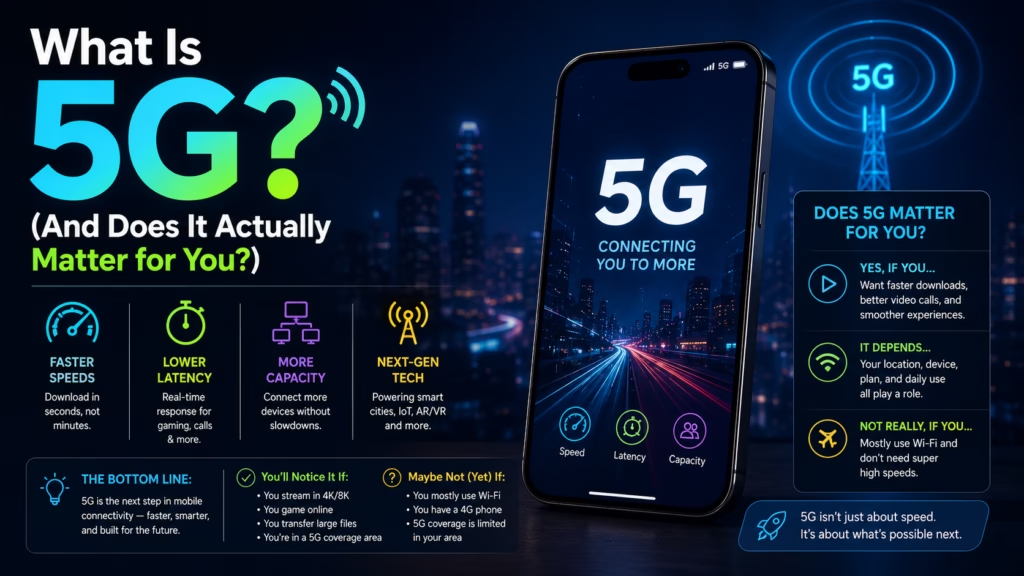
5G is the fifth generation of cellular network technology — the standard your phone uses to connect to the internet when you’re not on WiFi. It’s faster than 4G LTE in ideal conditions, with lower latency and higher capacity. In practice, how much faster depends heavily on which type of 5G your phone connects to and where you are. For most people today, 5G is nice to have but rarely life-changing — the bigger upgrade is usually your phone plan or WiFi.
Each “G” is a generation of wireless standards — a set of technical specifications that define how phones communicate with cell towers. The generations have rolled out roughly every decade: 1G in the 1980s (voice only), 2G in the 1990s (text messages), 3G in the 2000s (basic internet), 4G LTE in the 2010s (fast enough for streaming and apps), and 5G now.
Each generation brought meaningfully faster speeds and lower latency (the delay between sending a request and getting a response). 5G continues that trend — on paper, it’s significantly faster than 4G LTE. In the real world, what you experience depends on which flavor of 5G you’re actually connecting to.
Not all 5G is the same. Carriers deploy 5G on different frequency bands, each with very different characteristics:
Low-band 5G (Sub-1 GHz): The most widely deployed type. Covers large areas, penetrates buildings well — similar range to 4G LTE. The downside: speeds are only marginally faster than 4G. This is what most people connect to when their phone shows “5G” in a non-city location. It’s fine, but it’s not the revolutionary leap the marketing promised.
Mid-band 5G (2.5-3.7 GHz): The sweet spot. Significantly faster than 4G, with decent range and building penetration. If you’re in a major city and your phone connects to mid-band 5G, you’ll genuinely notice the speed improvement — downloads that took 30 seconds on 4G happen in a few seconds.
mmWave 5G (24-100 GHz): The version that delivers the headline speeds you see in carrier ads — gigabit speeds, almost no latency. The catch: it has extremely short range (think one city block) and can’t penetrate walls, glass, or even heavy rain. Currently available only in dense urban areas, mostly outdoors. Most people will never regularly use it.
“So when the carrier says ‘5G speeds up to 10 Gbps,’ they mean outdoors, in a specific part of a specific city, standing near a specific tower, in good weather?” — That’s essentially the mmWave situation, yes. “And the 5G I have is the slower kind that covers everywhere?” — For most locations, yes. “That’s a significant asterisk.” It’s doing a lot of work.
| Feature | 4G LTE | 5G (typical real-world) |
|---|---|---|
| Download speeds | 10-50 Mbps typical | 50-300 Mbps typical (mid-band) |
| Latency | 30-50ms | 10-20ms |
| Building penetration | Good | Good (low/mid-band), poor (mmWave) |
| Coverage | Excellent — nearly everywhere | Good in cities, patchy in rural areas |
| Battery impact | Baseline | Slightly higher drain (improving) |
For streaming video, browsing, social media, and most everyday tasks, 4G LTE is already fast enough that you won’t notice the difference. Where 5G mid-band makes a real difference: large file downloads, video calls in crowded areas (stadiums, concerts, city centers), and situations where lots of devices are competing for the same network capacity.
5G only works if your phone has a 5G modem. Most flagship phones released from 2020 onwards include 5G support — iPhones from iPhone 12 onward, and most Android flagships from the same period. Budget Android phones are more varied: some include 5G, many don’t.
You also need to be on a carrier plan that includes 5G access, and in a location where 5G coverage exists. All three conditions have to be true simultaneously.
If you’re due for a phone upgrade, getting a 5G-capable device is sensible future-proofing — 5G coverage will only expand. But buying a new phone specifically to get 5G, when your current phone works fine, is hard to justify for most people’s actual usage.
Honest answer: probably not as much as the marketing suggests. For most everyday usage — apps, social media, navigation, streaming — the limiting factor is rarely your cellular connection speed. Your experience is more affected by the app itself, your phone’s processing power, and whether you have a decent signal at all.
Where 5G starts mattering more: if you work heavily on mobile data without WiFi, travel frequently through major cities, or regularly do things like downloading large files on the go. For those use cases, mid-band 5G is a genuine quality-of-life improvement.
The network is also building infrastructure for future use cases — autonomous vehicles, smart city infrastructure, industrial IoT — that will genuinely require 5G’s lower latency and higher capacity. But those benefits are mostly downstream from what you need your phone to do today.
“My phone now shows 5G in the city and 4G when I’m at the park. I’ve decided I prefer the park.” — The park has trees and no cell towers. This is a reasonable trade-off. “Also better snacks.” Also better snacks.
5G is the fifth generation of cellular network technology — faster than 4G LTE with lower latency. There are three types: low-band (wide coverage, barely faster than 4G), mid-band (genuinely faster, good coverage in cities), and mmWave (extremely fast, extremely short range, rarely encountered in daily life). Most people experience low or mid-band 5G. The real-world improvement is noticeable in cities for data-heavy tasks but minimal for everyday browsing and streaming. iPhones 12 and newer and most Android flagships from 2020 onward support 5G. It’s worth having in a new phone but not worth upgrading your current phone for on its own.

Hi. I’m Ken. I run Two Second Solutions, a one-man agency that somehow landed a fox spirit influencer as a client. I drink too much coffee, blog when I need to vent, and regularly update my résumé just in case she sets the office on fire again. I’m not crying — it’s just spell residue.
By Ken Hollow, who was asked why the free one and the paid one aren’t the same thing if they have the same picture of…
By Ken Hollow, who explained the phrase “digital rights management” to a fox spirit and watched her become genuinely angry on behalf of a television…
By Ken Hollow, the man who told a fox spirit to “clear her cache” and had to explain that he wasn’t deleting the internet “Ken.…