Quiet Quitting, But For Creators: The Art of Posting Less and Caring Even Less
By Ken Hollow, exhausted digital manager to an immortal fox spirit with boundary issues Ah yes, “quiet quitting” — the corporate world’s favorite euphemism for…
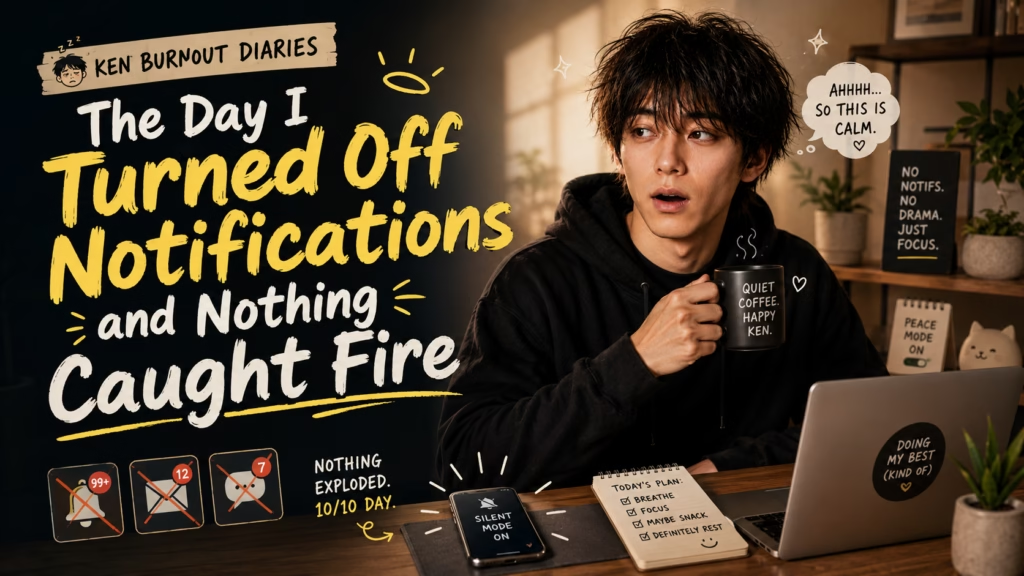
By Ken Hollow, the man who used to check his phone 80 times a day and considered this a personality trait rather than a problem
It started because Nana asked a question I couldn’t answer.
“Ken. Your phone has made a noise eleven times in the last hour. Are any of those noises important?”
I picked up my phone. A shipping update. Two marketing emails. A news alert about something I couldn’t change. A social media like. Three group chat messages that had resolved themselves without me. A weather notification for a city I visited six months ago and never removed. A calendar reminder for an event I’d already attended.
“No,” I said. “None of those are important.”
“Then why does your phone keep interrupting us?”
I didn’t have a good answer. So I did something I’d been meaning to do for years: I turned almost everything off.
I went through every app on my phone and disabled notifications for anything that wasn’t: (1) a direct message from a real person, (2) a time-sensitive alert I had specifically requested, or (3) something that would cause a real problem if I missed it. That eliminated about 90% of my notifications. I kept: calls, texts, calendar reminders, and my bank’s fraud alerts. Everything else went silent.
The first two days were genuinely strange. My hand kept reaching for my phone at the intervals I was used to — every 15-20 minutes, automatically, without a trigger. I’d pick it up, find nothing, and put it back down.
I also experienced what I can only describe as phantom notifications — a vague anxiety that something was happening somewhere that I was missing. Email piling up unread. Messages going unanswered. The internet moving on without me.
I checked manually. Nothing was on fire. The emails were still there when I opened the app. The messages had either resolved or were waiting patiently. The internet was fine without my real-time attention.
By day three, the phantom buzz started fading.
“You looked like a fox kit waiting for its mother for the first two days. Checking, finding nothing, checking again.” — That’s an accurate description of a dopamine loop, Nana. “Is that what I look like when I check if there are snacks?” Yes. We’re the same. “Distressing.”
After 30 days, here is everything I genuinely missed by not having notifications:
One time-sensitive work message that I responded to two hours late. The sender was fine. The situation had half-resolved itself by the time I replied.
A flash sale that ended before I saw it. I don’t remember what it was for.
That’s it. That’s the complete list.
What I expected to miss: everything. What I actually missed: almost nothing. Because it turns out that most notifications aren’t alerting you to things that require immediate action — they’re training you to open apps. The urgency is manufactured. The email that “just came in” is not different from the email that’s been waiting two hours. Your presence in a group chat in real time does not affect the outcome of the conversation.
Some changes were obvious. My phone battery lasted significantly longer — constant background notification activity and screen wake-ups drain battery in ways people underestimate. I picked up my phone less, so it spent more time in my pocket and less time on the table between us during meals.
Some changes were subtler. I started finishing things. When you’re not being interrupted every 15 minutes, tasks that used to take an hour of fragmented attention took 25 minutes of actual focus. The interruption cost isn’t just the notification itself — it’s the recovery time after, the refocusing, the mental context-switching. Research on this puts the recovery cost at anywhere from 5 to 23 minutes per interruption. I believe it.
The strangest change: I stopped feeling vaguely behind. That low-level anxiety of things piling up — messages unread, alerts unacknowledged — disappeared almost entirely, because I was no longer being constantly reminded that things existed to be dealt with. I checked my email on my terms, twice a day, and handled everything. The inbox was the same size. The stress was not.
“You’re less twitchy.” — That’s the most concise way anyone has described this to me. “You used to pick up your phone every time there was a pause in conversation. Now you just… sit in the pause.” Yes. “It’s better.” It is.
After experimenting, here’s what I kept on:
On: Phone calls. Text messages (SMS and iMessage). Calendar alerts. Bank fraud notifications. Health app reminders I specifically set. Find My (for device location).
Off: Every email app. Every social media app. Every news app. Every shopping app. Every delivery tracking app. Every app that sends “we miss you” or “here’s what you missed” notifications. Every game. Every streaming service. Every weather app (I look outside).
The rule I use now: A notification earns its place by being something that (a) requires my attention within the next hour and (b) I cannot retrieve by simply opening the app when I choose to. Almost nothing meets both criteria. Almost everything can wait until I decide to check.
On iPhone: Settings — Notifications. Tap each app. Ask: “Would my life be worse if this were off?” If the answer is no, turn it off. For most apps, the answer is no.
On Android: Settings — Notifications — App notifications. Same process. You can also long-press any notification when it appears and select “Turn off notifications” for that app — useful for catching ones you missed in the settings sweep.
The nuclear option: Turn everything off, then turn things back on only when you notice you’ve missed something important. Start from zero and add back only what proves necessary. This is more aggressive but surfaces very quickly which notifications you actually need.
I turned off almost all phone notifications for 30 days. In that time, I genuinely missed one slightly time-sensitive message and one forgotten flash sale. Everything else was fine — emails waited, conversations resolved, the world continued. Benefits: longer battery life, more focused work, less ambient anxiety, and actually being present in conversations. The setup that works: keep calls, texts, calendar, and bank alerts on; turn everything else off. The rule: a notification earns its place only if it requires action within the hour AND can’t simply be checked when you choose to open the app. Almost nothing qualifies.

Hi. I’m Ken. I run Two Second Solutions, a one-man agency that somehow landed a fox spirit influencer as a client. I drink too much coffee, blog when I need to vent, and regularly update my résumé just in case she sets the office on fire again. I’m not crying — it’s just spell residue.
By Ken Hollow, exhausted digital manager to an immortal fox spirit with boundary issues Ah yes, “quiet quitting” — the corporate world’s favorite euphemism for…
By Ken Hollow, reluctant fortune teller of corporate nonsense Let’s be honest: Key Performance Indicators (KPIs) are just tarot cards with pie charts. Managers shuffle…
By Ken Hollow, professional hostage, unpaid therapist, digital manager of questionable life choices Managing an influencer in 2025 is already enough to shave years off…