The Group Chat Is a Full-Time Job
By Ken Hollow, professional tab juggler and part-time actual worker Every freelancer has their own productivity kryptonite. For some, it’s TikTok. For others, it’s the…
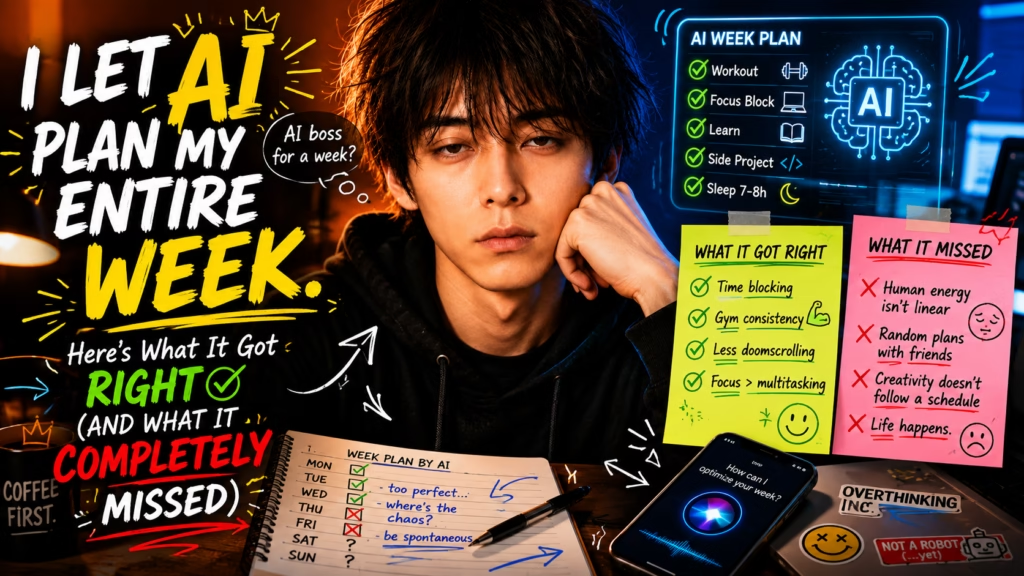
By Ken Hollow, the man who outsourced his executive function to a language model for seven days and has feelings about it
It started as an experiment. It became something else.
I’ve been managing my attention more carefully for a while now — fewer notifications, more intentional focus blocks, less reactive scheduling. But I still spend a non-trivial amount of time every Sunday deciding what the week should look like, shuffling tasks around when things go sideways, and negotiating with myself about what actually needs to happen versus what I’m avoiding.
So I gave that job to an AI for a week. Full handoff. I put in my task list, my deadlines, my calendar, my rough sense of how long things take, and my preferences (mornings for writing, afternoons for calls, one hard focus block per day minimum). Then I let it build the schedule and — this was the important part — I committed to following it.
Here’s what happened.
It had no feelings about difficult tasks. I’ve been avoiding a client deliverable for two weeks. It was on my list every week. Every week I moved it. The AI looked at the deadline, looked at the estimated time, and put it on Tuesday morning without negotiation or commentary. Tuesday morning I did it. It took three hours. It was fine. I had been deferring something for two weeks that was fine.
This is, I think, the most useful thing an AI scheduler does: it has no emotional relationship with your tasks. It doesn’t know that you find the deliverable unpleasant. It just sees a deadline and a duration and puts it in the most logical slot. Your feelings about the task are not its problem.
It batched better than I do. I tend to scatter similar tasks throughout the week — a few emails Monday, a few emails Wednesday, some more Friday. The AI grouped all my email processing into two daily 30-minute windows. This sounds minor. The difference in cognitive load was not minor. Context switching between deep work and email is more expensive than I had been accounting for, and I’d been doing it constantly without realising.
It protected my mornings. I have a standing tendency to let morning focus time get nibbled away by “quick” tasks that aren’t quick. The AI scheduled nothing in mornings except the work that required genuine concentration. When I tried to mentally negotiate on Wednesday (“I’ll just check in on that one thing”), I remembered I’d committed to following the schedule. I didn’t check in. The morning was intact.
It had no idea when I was actually tired. Thursday afternoon was scheduled for a medium-complexity writing task. Thursday afternoon I had had a difficult call Wednesday evening that I hadn’t put in the system, slept poorly, and had the cognitive capacity of a damp sponge. The schedule said write. I tried to write. What I produced was unusable and demoralising. The AI had no mechanism for “this human is running at 40% today, route accordingly.”
It couldn’t account for the invisible tax of other people. Nana interrupted me four times on Monday. A client sent an urgent message that wasn’t actually urgent but felt like it needed acknowledging. A supplier needed a decision I hadn’t anticipated. None of these were on the schedule. All of them had a cost. By Monday afternoon I was 90 minutes behind a schedule built on the assumption that the world would cooperate, which the world does not do.
It optimised for efficiency without accounting for energy. Back-to-back focus blocks are theoretically efficient. In practice, by block three I was diminished. An experienced human scheduler (me, on a good week) would have put a walk or a low-friction task between the demanding ones. The AI stacked the hardest things in the most productive hours, which is correct in theory and unsustainable in practice over five days.
“You gave a machine your week and it didn’t know you were tired on Thursday.” — Correct. “Because you didn’t tell it you were tired on Thursday.” Also correct. “So the failure was the machine not being psychic, not the machine being wrong.” …That’s a fair characterisation. “You needed a system that adapts, not just one that plans.” Yes. That’s exactly the thing I learned.
I didn’t abandon AI scheduling. I rebuilt the handoff.
Now I do a two-minute “state check” each morning before looking at the schedule: energy level (1-10), any new context the AI doesn’t have, one thing that changed overnight. I feed that in and ask for a daily adjustment. The combination of AI planning (no feelings about difficult tasks, good at batching, respects the preferences I set) plus morning human context (here’s what the AI can’t see) is meaningfully better than either approach alone.
The week I followed the AI schedule without modification was a useful experiment. It revealed where my own scheduling was genuinely worse than the machine’s (task avoidance, poor batching), and where my own judgment is irreplaceable (energy management, unexpected context, the reality that other people exist and have needs).
It also revealed that the client deliverable I’d avoided for two weeks was fine. That part I could have done without a week-long experiment, but here we are.
AI scheduling is genuinely useful for: eliminating task avoidance, batching similar work, protecting focus time, and removing the emotional overhead of deciding what to work on. It is not useful for: knowing when you’re running low, accounting for the unpredictable texture of actual days, or replacing the human judgment that comes from living in your own head.
Use it as a starting point, not a final answer. Give it your constraints, your preferences, your deadlines. Take what it builds seriously — especially for the tasks you’ve been avoiding. Then adjust each morning with the information it can’t have.
And maybe tell it when you slept badly. Even if it can’t do much with that yet, the habit of noticing is worth something on its own.
I handed an AI my full task list, calendar, and preferences and followed its schedule for one week. What worked: it had no feelings about tasks I’d been avoiding, batched similar work better than I do, and protected my morning focus time. What failed: it had no way to know I was exhausted Thursday, couldn’t account for the constant interruptions and unplanned context that make up a real day, and optimised for efficiency in ways that weren’t sustainable across five consecutive days. The fix: use AI planning as the starting point, then do a two-minute morning check-in to give it the context it can’t see. The best result came from combining machine planning (no avoidance, good batching) with human judgment (energy, unexpected reality, other people’s existence). The client deliverable I’d avoided for two weeks took three hours. It was fine. That alone might have been worth the experiment.

Hi. I’m Ken. I run Two Second Solutions, a one-man agency that somehow landed a fox spirit influencer as a client. I drink too much coffee, blog when I need to vent, and regularly update my résumé just in case she sets the office on fire again. I’m not crying — it’s just spell residue.

By Ken Hollow, professional tab juggler and part-time actual worker Every freelancer has their own productivity kryptonite. For some, it’s TikTok. For others, it’s the…
By Ken Hollow, professional ghost on LinkedIn and full-time internet burnout. Every morning I wake up, open my eyes, and immediately remember that I exist…
By Ken Hollow, unwilling participant in sticky-note theater Brainstorming is the corporate equivalent of a séance: a bunch of people gather in a room, chant…