Notes From the Edge of a Breakdown
Hi. I’m Ken.I manage Nana Vix — self-declared enchantress, influencer, and fox-shaped corporate liability. This blog is where I post: Basically, this is where I…
By Ken Hollow, the man who once sat in a 90-minute meeting about the agenda for a future meeting and had to explain this to a fox spirit without losing his composure
“Ken. You’ve been on a call for an hour and a half.”
“I know.”
“What was it about?”
“We were deciding when to have the real meeting.”
“…”
“Yeah.”
“That’s a meeting about a meeting.”
“Welcome to corporate life.”
“I want no part of this.”
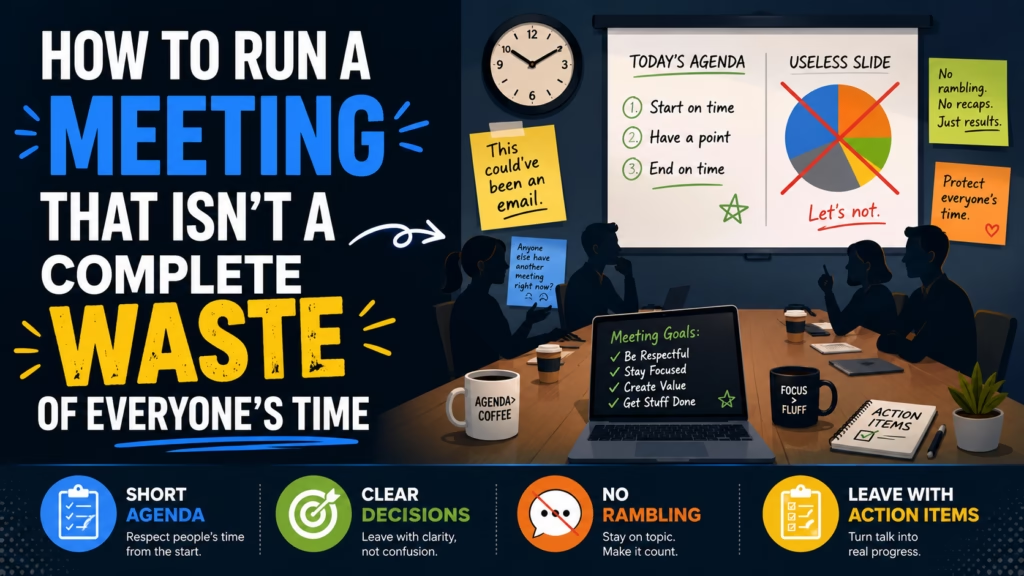
Reasonable position. Meetings are the single most complained-about feature of professional life, and the complaints are mostly justified. But the problem isn’t meetings — it’s meetings with no clear purpose, no preparation, no decisions, and no end time anyone respects. Those are fixable. Here’s how.
A meeting should exist to do one of three things: make a decision that requires group input, share information that requires real-time discussion, or solve a problem that can’t be solved asynchronously. If your meeting doesn’t fit one of those three purposes, it probably shouldn’t be a meeting. The agenda, invite list, and time limit all flow from knowing which one you’re doing.
Before scheduling a meeting, answer these honestly:
1. What decision or outcome do I need from this? Not “to discuss X” — a specific decision or output. “To decide whether we launch in Q3 or Q4.” “To align on the final design before handoff.” “To troubleshoot why the campaign numbers are off.” If you can’t name a specific outcome, the meeting isn’t ready to be scheduled.
2. Does this require a live conversation? A lot of meetings are really emails that got scared. Status updates, announcements, information sharing that doesn’t require discussion — these belong in written form, not in a 30-minute calendar block. A good test: could you send a well-written email and get what you need? If yes, send the email. (We covered how to write one that actually works here.)
3. Who actually needs to be there? Invite the people whose input is required to reach the outcome. Not everyone who might find it interesting. Not your manager “for visibility.” Not the whole team by default. Every extra person in the room costs their time and dilutes the decision-making — more voices don’t always mean better outcomes.
An agenda isn’t a list of topics — it’s a list of decisions or questions to be resolved, with a time allocation for each and any materials people need to review beforehand.
Bad agenda:
– Project update (30 min)
– Budget (15 min)
– Next steps (15 min)
Good agenda:
– Decide: do we extend the launch timeline or proceed with current scope? [15 min] — please read the attached scope doc before joining
– Decide: which of the two budget options does the team approve? [10 min] — options summary in the doc
– Assign owners to the three outstanding action items [5 min]
The difference: the good agenda tells people exactly what will be decided, how long each item gets, and what to read before the call. People arrive prepared instead of hearing information for the first time during the meeting and needing time to process it.
Send the agenda — with any relevant documents — at least 24 hours before the meeting. If you can’t do that, the meeting isn’t ready.
“So a meeting agenda should tell you what will be decided, not just what will be talked about?” — Exactly. Talking and deciding are different things. Talking is cheap. Deciding is the point. “Most meetings I’ve heard about seem to involve a lot of the first and very little of the second.” Most meetings do.
Start on time. Waiting for latecomers punishes everyone who arrived when they were supposed to. Start at the scheduled time. Latecomers catch up. People learn.
Appoint a facilitator. Someone needs to be explicitly responsible for keeping the conversation on track and on time. This doesn’t have to be the most senior person — it’s a role, not a status marker. The facilitator’s job: keep each agenda item within its time box, redirect tangents, and ensure each item ends with a clear decision or action.
Timebox each agenda item. When an item’s time is up, either make the decision with the information available or explicitly schedule a follow-up for that specific item. Don’t let a single agenda item balloon and consume the rest of the meeting.
Decisions out loud. When a decision is reached, state it explicitly: “So we’re agreeing to push the launch to Q4 — is everyone aligned?” Get verbal confirmation. Silence is not consensus. The number of post-meeting disputes that begin with “I thought we decided…” is directly proportional to how many decisions were left implicit.
Action items with owners and deadlines. Every action that comes out of the meeting needs three things: what, who, and by when. “Someone will look into the pricing” is not an action item. “Marcus will send the updated pricing model to the group by Thursday EOD” is.
Reserve the last five minutes of every meeting to explicitly cover:
1. What decisions were made today
2. What action items came out of it, with owners and deadlines
3. Is a follow-up meeting needed — and if so, what specifically needs to happen before that meeting takes place
This five-minute wrap prevents the meeting from ending in a vague fog where people leave with different understandings of what was agreed. It takes five minutes and saves hours of follow-up confusion.
Within a few hours of the meeting, send a short summary to all attendees (and anyone who was affected but not present). It should be brief — not a transcript. Decisions made. Action items with owners and deadlines. Any open questions that weren’t resolved.
This serves as the official record of what was decided, a reference point for anyone whose memory of the meeting differs from reality, and accountability for the action items. It takes ten minutes and has an outsized impact on whether the meeting actually produced anything.
“So the meeting has a before (agenda and prep), a during (facilitation and decisions), and an after (summary and follow-through). It’s a whole process.” — Yes. Most people only think about the during. The before and after are where meetings actually earn their time. “People spend an hour talking and then wonder why nothing changes.” They do. Every time.
A meeting can be cancelled or converted to an email if: the decision was already made, the information can be shared in writing, key decision-makers can’t attend and the meeting can’t achieve its outcome without them, or the agenda hasn’t been prepared and the meeting would be reactive and unfocused.
Cancelling a meeting that doesn’t have a clear purpose is not laziness — it’s giving everyone an hour of their day back. In most organisations, that’s a gift.
A meeting should exist to make a decision, discuss something that requires live interaction, or solve a problem that can’t be handled asynchronously — nothing else. Before scheduling: define the specific outcome needed, confirm it requires a meeting rather than an email, and invite only people essential to that outcome. The agenda should list decisions to be made (not just topics) with time allocations, sent 24 hours in advance with relevant documents. During: start on time, use a facilitator, timebox each item, state decisions explicitly, assign action items with owners and deadlines. After: send a brief written summary within a few hours. The five-minute end-of-meeting wrap and the follow-up summary are the two most skipped and highest-value steps.

Hi. I’m Ken. I run Two Second Solutions, a one-man agency that somehow landed a fox spirit influencer as a client. I drink too much coffee, blog when I need to vent, and regularly update my résumé just in case she sets the office on fire again. I’m not crying — it’s just spell residue.

Hi. I’m Ken.I manage Nana Vix — self-declared enchantress, influencer, and fox-shaped corporate liability. This blog is where I post: Basically, this is where I…

By Ken Hollow, the man who once received a six-paragraph email asking whether Tuesday worked for a meeting and had to explain this to a…