Notes From the Edge of a Breakdown
Hi. I’m Ken.I manage Nana Vix — self-declared enchantress, influencer, and fox-shaped corporate liability. This blog is where I post: Basically, this is where I…
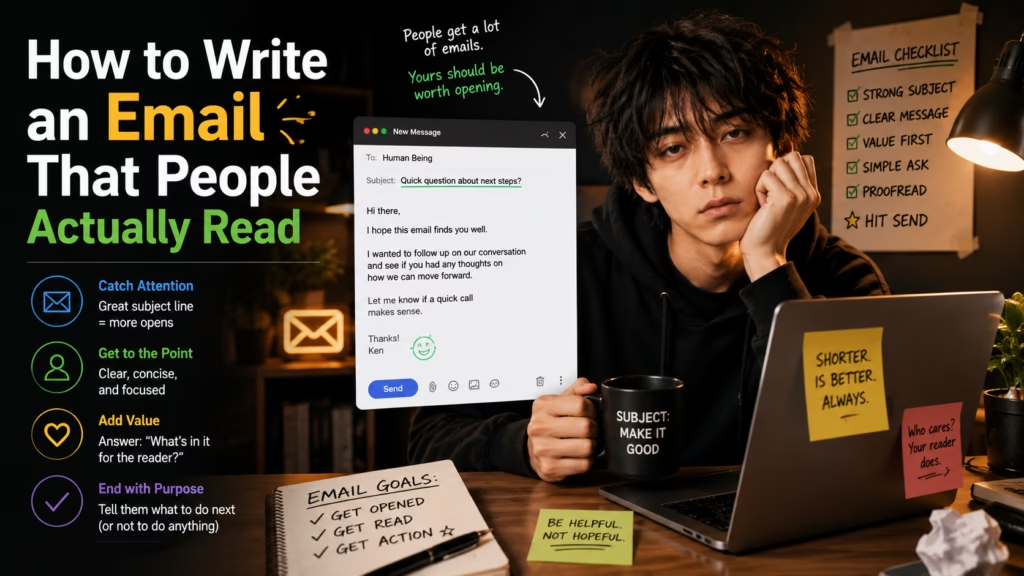
By Ken Hollow, the man who once received a six-paragraph email asking whether Tuesday worked for a meeting and had to explain this to a fox spirit as though it were a normal thing humans do
“Ken. Someone sent you an email. It is very long. The question is in the last paragraph.”
“I know.”
“Why didn’t they put the question first?”
“I don’t know, Nana.”
“Did they think you needed context before you were ready to receive a question?”
“Possibly.”
“That seems like a lot of faith in your patience.”
She’s right. Most people’s patience for work email is extremely limited. The average professional receives dozens to hundreds of emails a day. The ones that get read, understood, and acted on share a specific set of qualities. The ones that get skimmed, misunderstood, or quietly ignored share a different set. Here’s how to write the first kind.
Put the most important thing first. The request, the decision needed, the deadline, the key information — whatever the reader most needs to know goes in the first two sentences, not the last paragraph. Everything else is context that supports the thing you already told them. Most email problems come from inverting this structure.
Every effective work email follows roughly the same architecture:
Line 1: The point. What do you need? What are you telling them? What decision needs to be made? State it plainly and immediately. “Can you review the attached report by Thursday?” “The client moved the deadline to Friday.” “I need your approval on the budget before I can proceed.” One sentence. Done.
Lines 2-4: The essential context. What does the reader need to know to act on line 1? Not everything you know — only what they need. The background that changes how they’d respond. The relevant constraint. The thing that makes this request make sense.
Optional: Supporting detail. Anything that might come up as a follow-up question. Keep this short. If it runs to multiple paragraphs, consider whether it belongs in an attachment or a separate conversation.
Close: One clear action. What specifically do you need from them, and by when? “Please reply by EOD Wednesday.” “Let me know if you can join.” “No response needed — just keeping you informed.” Give them exactly one thing to do.
“So an email is: here is the thing, here is why, here is what I need from you?” — Yes. That’s the whole framework. “Why don’t people do that?” Habit, anxiety, trying to seem thorough, not wanting to seem demanding. “Those are all bad reasons.” They are.
The subject line is the headline. It determines whether your email gets opened now, later, or quietly archived. A good subject line tells the reader exactly what’s inside and whether it requires action.
Bad subject lines:
“Quick question” — every email has a question. This says nothing.
“Following up” — following up on what?
“RE: RE: RE: RE: Meeting” — no one knows what this chain is about anymore.
“Hi” — this is not a subject line.
Good subject lines:
“Budget approval needed by Thursday” — action, deadline, topic.
“Q3 report attached — no action needed” — they know immediately this is FYI only.
“Can we move Friday’s meeting to 3pm?” — the entire email is in the subject line. Sometimes that’s the right call.
The test: could someone read only your subject line and know (a) what the email is about and (b) whether they need to do something? If yes, it’s a good subject line.
Most work emails should be 3-7 sentences. Not paragraphs — sentences. If you’re writing more than that, ask yourself whether you’re adding necessary information or reassuring yourself that you’ve been thorough.
Long emails create several problems: they take longer to read, important information gets buried, readers often skim and miss key details, and they signal to the reader that responding will be an effort — which delays responses.
If a topic genuinely requires extensive explanation, consider whether it belongs in a document attached to a short email (“Please review the attached brief — I need your feedback on sections 2 and 3 by Friday”), a meeting, or a phone call. Email is a poor format for complex decision-making.
Each email should ask for one thing. Not three things in three different paragraphs. One thing.
When an email contains multiple asks, readers typically respond to the easiest one and subconsciously defer the others. Or they respond to the first one and forget the rest. Or they feel the email requires more effort than they have right now and put it off entirely.
If you have three separate things to ask the same person, send three short emails. This sounds counterintuitive but it works: each ask is visible as its own thread, each can be acted on independently, and none gets buried under the others.
“This is why you send me short messages. I thought you were being curt.” — I’m being efficient. “I’ve been sending you messages with four questions in them for years.” You have. “And you always answer the most convenient one.” I answer the most actionable one. “That’s the same thing.” Often, yes.
Many people default to stiff, formal language in work emails because it feels “professional.” It often isn’t. Formal language that obscures meaning is just hard to read.
“Please be advised that the aforementioned deliverable has been finalized and is attached herewith for your review and consideration” means “The report is attached.” Write the second version.
Professional tone means being clear, direct, and respectful — not using longer words when shorter ones work. It means not being casual in contexts that require formality (a first email to a new client isn’t “hey!”), but it also doesn’t mean writing like a legal document when you’re asking a colleague if they can make a 10am call.
Read your email out loud before sending. If it sounds like a person wrote it, good. If it sounds like a terms-of-service document, revise.
Before hitting send, ask:
1. Does the first sentence contain the main point? If not, move it.
2. Does the subject line tell them what this is and whether action is needed? If not, rewrite it.
3. Is there exactly one ask? If there are multiple, consider splitting.
4. Does it pass the “read out loud” test? If it sounds robotic, simplify.
5. Can anything be cut? Remove it. The reader will thank you silently.
The single most important rule: put the point first, not last. State what you need in the first sentence, provide only the context required to act on it, and close with one clear action and a deadline if relevant. Subject lines should tell the reader what’s inside and whether action is needed — “Quick question” does neither. Most work emails should be 3-7 sentences. One email, one ask — multiple asks in one email means some will be missed. Clear beats formal: write like a person, not a legal document. Before sending: does the first line contain the main point? Is there one clear ask? Can anything be cut?

Hi. I’m Ken. I run Two Second Solutions, a one-man agency that somehow landed a fox spirit influencer as a client. I drink too much coffee, blog when I need to vent, and regularly update my résumé just in case she sets the office on fire again. I’m not crying — it’s just spell residue.

Hi. I’m Ken.I manage Nana Vix — self-declared enchantress, influencer, and fox-shaped corporate liability. This blog is where I post: Basically, this is where I…
By Ken Hollow, the man who once sat in a 90-minute meeting about the agenda for a future meeting and had to explain this to…