When Should You Actually Replace Your Phone? (The Honest Answer)
By Ken Hollow, the man who has been asked by a fox spirit to justify the continued existence of a phone that is, in her…
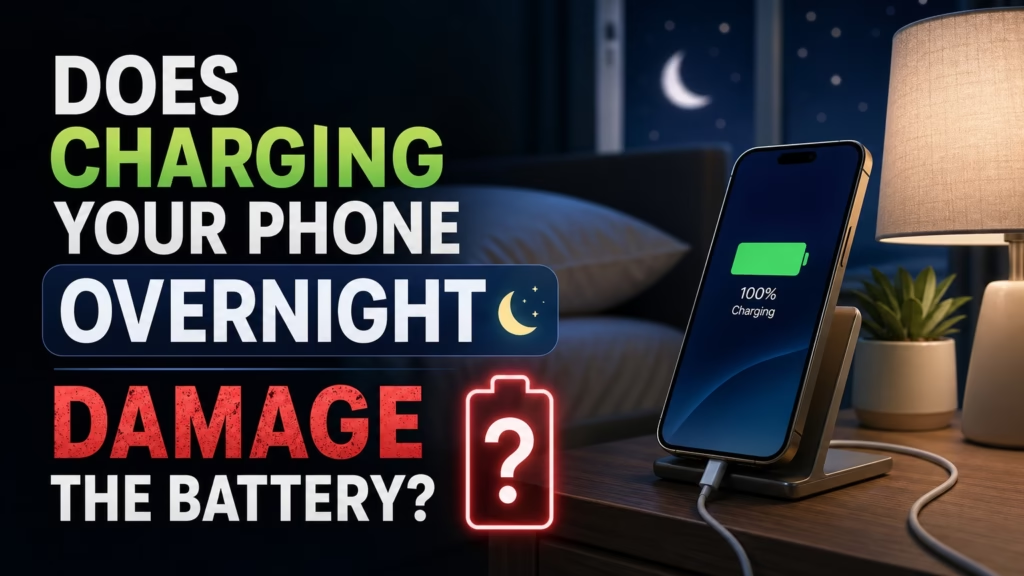
By Ken Hollow, the man who once found a phone charging under a pillow at 3am and had to explain the concept of “thermal runaway” to someone who was convinced the warmth was “the phone dreaming.”
“Phones don’t dream, Nana.”
“Then explain why it’s warm and making gentle buzzing sounds.”
“That’s a notification. From the app you left open. Please stop putting electronics under soft furnishings.”
This is one of the oldest debates in tech: is it bad to leave your phone plugged in all night? Your dad says yes. Apple’s support page says it’s fine. Reddit has 47 conflicting opinions. Here’s what’s actually going on in 2026.
No, charging your phone overnight will not damage or destroy your battery — modern phones stop charging when they reach 100%. But keeping the battery at 100% for extended hours does create mild stress that, over many months, slightly reduces its long-term capacity. The effect is real but small. You’re better off using your phone’s built-in optimised charging feature than setting an alarm to unplug at 2am.
Older battery technologies — particularly nickel-cadmium batteries from the 1990s and early 2000s — could genuinely be damaged by overcharging. They had the “memory effect,” where partial charges would reduce total capacity over time, and overcharging could cause overheating or swelling.
Modern smartphones use lithium-ion or lithium-polymer batteries, which work completely differently. Every phone built in the last decade has a Battery Management System (BMS) — a chip that monitors the charge level and cuts off power once the battery hits 100%. Your phone physically cannot overcharge. The charger doesn’t keep forcing electricity into a full battery.
So the “overcharging will destroy your battery” fear? That one’s dead. But the real story is more nuanced than “it’s totally fine.”
“So the phone has a tiny guardian inside it that stops the electricity when the battery is full? That’s not engineering. That’s a ward. My phone has a ward. I feel safer already.”
When your phone reaches 100% and stays on the charger, the BMS cuts off charging. But your phone doesn’t just sit there inert — it’s still running background processes, checking for notifications, syncing data. These tasks drain tiny amounts of battery.
When the level drops slightly below 100% (to maybe 99%), the charger tops it back up. This cycle — called trickle charging or maintenance charging — repeats throughout the night. Each top-up is tiny, but it keeps the battery sitting at or near 100% for 6-8 hours.
The issue isn’t overcharging. It’s time spent at high voltage. Lithium-ion batteries experience the most chemical stress when held at very high or very low charge levels. Sitting at 100% for hours puts mild but continuous stress on the battery’s internal chemistry. Over hundreds of nights, this marginally reduces the battery’s total capacity — meaning after two years, your battery might hold 85% of its original capacity instead of 88%.
Is that difference worth losing sleep over (literally)? For most people, no.
Phone manufacturers know about this, and most have already built solutions into the software:
iPhone — Optimised Battery Charging: Your iPhone learns your daily routine and, if you typically unplug at 7am, it’ll charge to 80% quickly and then hold there overnight, only completing the charge to 100% shortly before you wake up. This is on by default in Settings → Battery → Battery Health & Charging.
Samsung — Adaptive Battery / Protect Battery: Samsung offers a “Protect Battery” toggle that caps charging at 85%, preventing the battery from spending extended time at full charge. You’ll find it in Settings → Battery → Battery Protection.
Google Pixel — Adaptive Charging: Similar to Apple’s approach — the Pixel learns when you usually unplug and slows down charging overnight to avoid sitting at 100% for hours.
If you have a phone from the last 3-4 years and haven’t disabled these features, your phone is already managing overnight charging better than you could manually.
“My phone LEARNS when I wake up? Ken, that’s not a feature. That’s my phone watching me sleep. I’m putting tape over the camera tonight.”
If you’re worried about battery health, here’s where to focus your energy — because these factors matter far more than when you unplug:
Heat. This is the number one battery killer. Charging your phone in a hot car, leaving it in direct sunlight, or charging it under a pillow or blanket traps heat and accelerates battery degradation significantly. A phone charging on a cool nightstand overnight does less damage than one charging for 30 minutes in a hot car.
Consistently draining to 0%. Deep discharges stress lithium-ion batteries more than staying near full. The ideal range for battery longevity is roughly 20-80%, but this is a guideline, not a rule you need to obsess over. Letting your phone die occasionally won’t ruin anything — doing it daily might have a measurable effect over a couple of years.
Using cheap, uncertified chargers. Non-certified chargers may lack proper voltage regulation and overheat protection. This can deliver inconsistent power that generates excess heat. Use chargers that are MFi-certified (for iPhone) or from reputable brands with proper safety certifications.
Fast charging all the time. Fast charging generates more heat than standard charging. It’s perfectly safe and won’t damage your battery in the short term, but using standard-speed charging overnight (when you don’t need the speed) produces less heat and is marginally better for long-term battery health.
| ✅ Do This | ❌ Don’t Bother With This |
|---|---|
| Enable your phone’s optimised/adaptive charging feature | Setting an alarm to unplug at 2am |
| Charge on a hard, cool surface (nightstand, desk) | Obsessing over keeping the battery between 20-80% at all times |
| Use a certified charger from a reputable brand | Buying a smart plug just to cut power at a specific percentage |
| Avoid charging in extreme heat (hot car, direct sunlight) | Draining to 0% before every charge “to calibrate the battery” |
“I have been charging my phone under my pillow for warmth and companionship for two years. Ken just told me this is the worst possible thing I could be doing for the battery. I said it’s not about the battery, Ken. It’s about the emotional bond. He left the room.”
Charging overnight won’t destroy your battery — modern phones stop charging at 100% automatically. The real (but minor) concern is that keeping the battery at full charge for many hours creates slight chemical stress over time. Your phone’s built-in optimised charging features already handle this. The things that actually damage batteries are heat, cheap chargers, and consistently draining to 0%. Charge on a cool surface, use a decent charger, and let your phone’s software manage the rest. Sleep well.

Hi. I’m Ken. I run Two Second Solutions, a one-man agency that somehow landed a fox spirit influencer as a client. I drink too much coffee, blog when I need to vent, and regularly update my résumé just in case she sets the office on fire again. I’m not crying — it’s just spell residue.
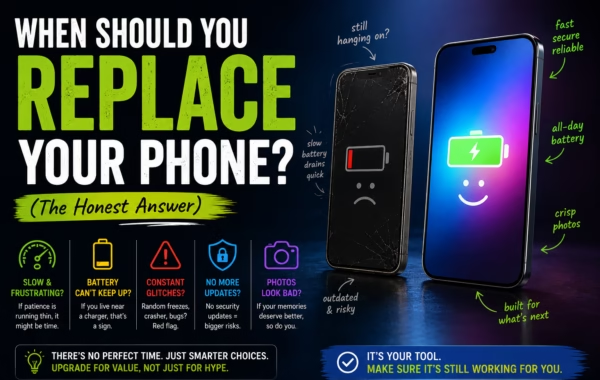
By Ken Hollow, the man who has been asked by a fox spirit to justify the continued existence of a phone that is, in her…
By Ken Hollow, who enabled a battery setting and then spent three weeks being told the phone was “broken on purpose, by you” “Ken. My…
By Ken Hollow, personal AV technician for a fox spirit who believes anything smaller than a 55-inch screen is “an insult to content” The request…